31 October 2026
Why Flux 3 Matters for Real-World AI and Visual Intelligence
Presented by @theflux3insight
The AI landscape has shifted again
For the past few years, generative AI has been moving in two directions at once. On one hand, models got bigger and more capable. On the other, they became more specialised - separate systems for images, video, audio, and text. The result was a fragmented toolkit. If you wanted to build something that understood a scene from a photo and also generated a spoken description, you had to stitch together three or four different models. That approach works, but it introduces latency, error propagation, and maintenance overhead. The release of FLUX 3 by Black Forest Labs signals a deliberate move away from that fragmentation.
FLUX 3 is a multimodal foundation model that collapses several formerly separate capabilities into one unified architecture. It handles image generation, video generation, audio generation, and natural language processing within the same framework. That is not just a convenience. It changes how we think about real-world AI systems, because the model can learn relationships across modalities that siloed models cannot. For example, it can observe a video of someone pouring water into a glass and simultaneously generate a textual caption, an audio track of the pouring sound, and a still image of the final filled glass. That kind of cross-modal learning is what makes the model interesting for applied work.
What "multimodal" actually means in practice
Multimodal foundation models have been discussed in research papers for a while, but most production systems still rely on separate components. You might have a text-to-image model, a separate text-to-video model, and a third model for text-to-audio. Each one has its own training data, its own inference pipeline, and its own quirks. Aligning them so they produce consistent outputs across modalities is a major engineering challenge. FLUX 3 sidesteps that by training a single model on data that spans all those modalities. The result is that the model learns shared representations. When it generates a video, it implicitly understands the visual structure, the temporal flow, and the likely audio that goes with it. That is the kind of coherence that separate models struggle to achieve.
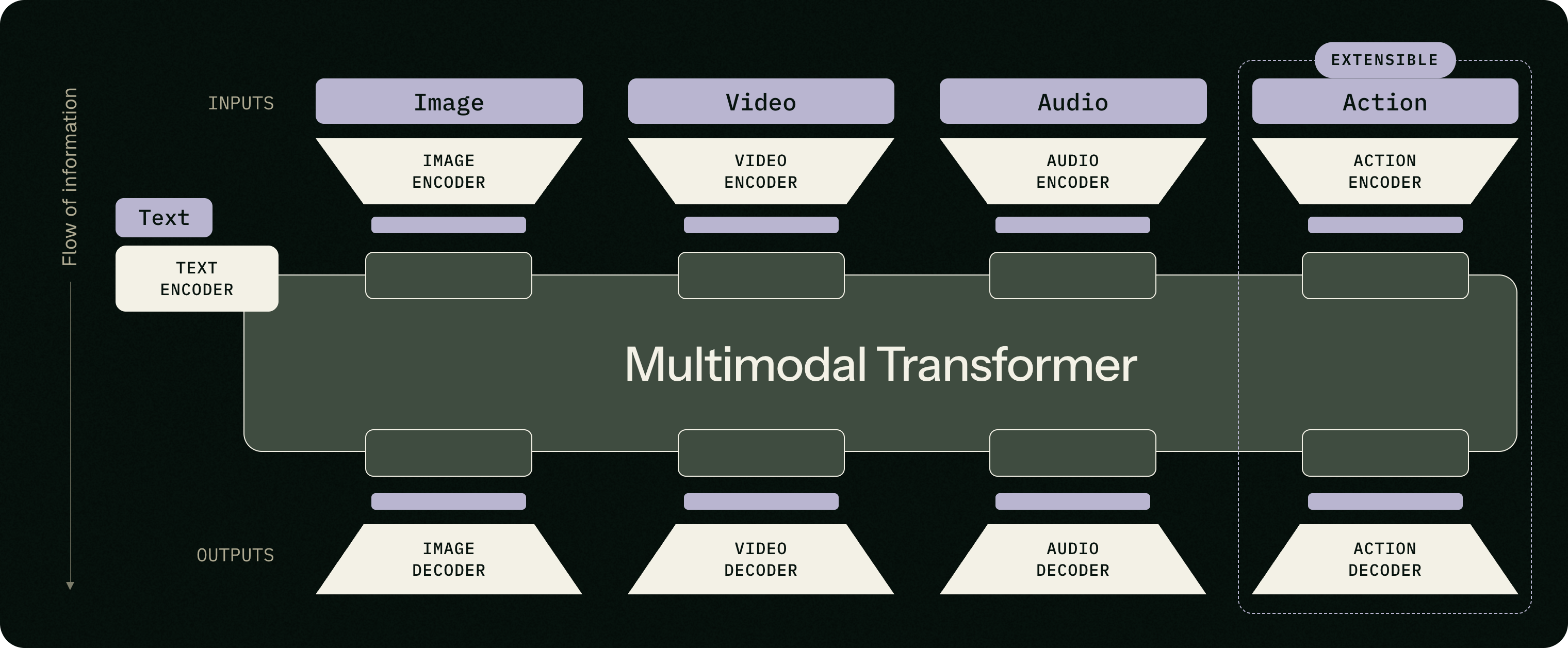
From a practical standpoint, this matters for anyone building end-to-end applications. If you are working on assistive technology, content production pipelines, or simulation tools, the less you have to orchestrate between models, the more reliable your system becomes. The trade-off is that training a single model across so many modalities requires enormous compute and data resources. Black Forest Labs has invested heavily in model scalability to make this feasible, and the results so far suggest that the unified approach can match or exceed the quality of specialised models on individual tasks.
Diffusion meets transformer architecture
The technology behind FLUX 3 is worth understanding at a high level because it explains why the model behaves the way it does. Like many recent generative AI systems, FLUX 3 builds on diffusion models. Diffusion works by starting with pure noise and gradually denoising it into a coherent output - an image, a video frame, or an audio waveform. But diffusion alone has trouble capturing long-range dependencies, especially in video or audio where structure unfolds over time. That is where transformer architecture comes in. By incorporating transformer layers, the model can attend to distant parts of the sequence, whether those are spatial regions in an image, frames in a video, or samples in an audio clip.
This hybrid approach is not entirely new, but FLUX 3 applies it across modalities in a way that feels deliberate. The transformer handles the global structure, the diffusion process refines the local details, and the shared embedding space allows the model to transfer knowledge from one modality to another. For example, if the model has learned what a dog looks like from images, it can apply that knowledge when generating a video of a dog running. It also knows what a dog bark sounds like from audio training data. The cross-modal learning that happens during training means the model does not have to rediscover those relationships from scratch for each modality.
Visual intelligence beyond static images
Computer vision has traditionally been about static images - classification, segmentation, object detection. Those tasks are still important, but real-world AI demands more. A system that can only understand a single photo misses the context of motion, sound, and language that surrounds every scene. FLUX 3 positions itself as a step toward visual intelligence that accounts for that richer context. Because it can process and generate video and audio alongside images, it can model scenes as dynamic events rather than frozen snapshots.
Consider a surveillance application. A traditional computer vision model might flag a person walking across a frame. A multimodal model like FLUX 3 can also listen for footsteps, generate a textual log of the event, and produce a short video clip of the relevant segment - all from the same underlying representation. That kind of integration reduces the need for custom pipelines and makes the system more robust to edge cases. The same logic applies to content creation, where a single model can take a text prompt and produce a coordinated output of image, video, and audio that feel like they belong together.
Where the trade-offs live
No model is perfect, and FLUX 3 has limitations that practitioners should keep in mind. The main one is inference cost. Because the model is large and handles multiple modalities, running it locally is not realistic for most setups. Cloud-based AI inference is the practical path, which means latency and cost can add up if you are generating a lot of content. There is also the question of fine-tuning. If you need a model that specialises in, say, medical imaging or industrial audio, a generalist multimodal foundation model may not perform as well as a smaller, dedicated model trained on that specific domain. The breadth of FLUX 3 is a strength, but it also means the model trades some depth for that breadth.
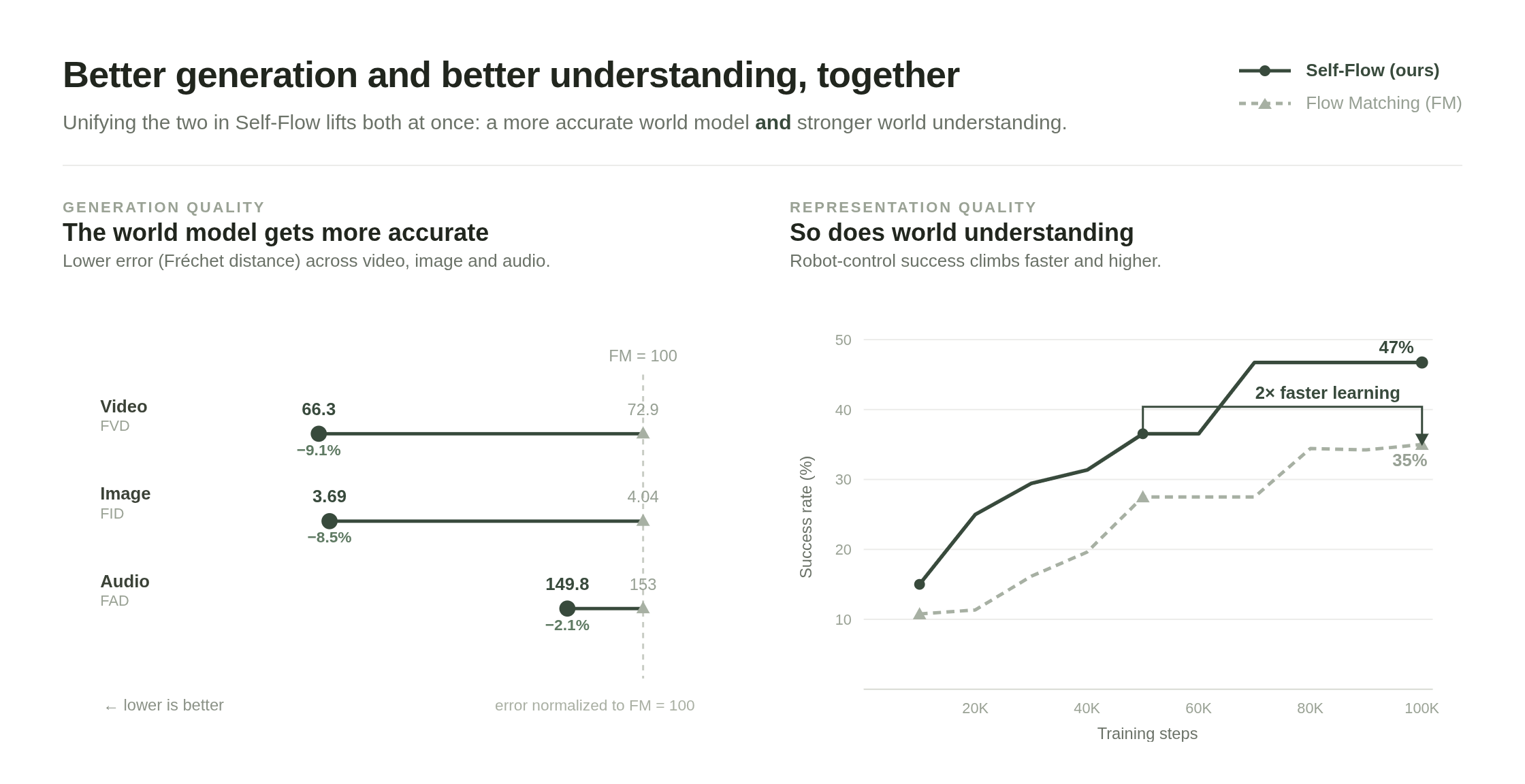
Another consideration is data quality. Training a unified model on such diverse data requires careful curation. If the training data has biases or gaps in one modality, those issues can bleed into other modalities through the shared representations. Black Forest Labs has published limited details about their data sourcing, so users should evaluate the model on their own data before relying on it in production. That said, the model's performance on standard benchmarks for text-to-image, text-to-video, and text-to-audio tasks has been competitive, which suggests the training data is reasonably comprehensive.
Practical takeaways for builders
If you are evaluating whether to use FLUX 3 in a project, here are a few things to consider:
- Start with a clear definition of which modalities you actually need. If you only generate images, a specialised model may be more efficient. If you need two or more, the unified architecture saves you integration work.
- Test the model on your own edge cases. Benchmarks are useful, but real-world data always reveals surprises. Run a small pilot before committing to the full pipeline.
- Plan for inference cost. Multimodal generation is heavier than single-modality. Budget accordingly, and consider caching results that can be reused.
- Monitor for cross-modal artifacts. Because the model shares representations, a glitch in one modality can affect others. Build quality checks that look at all outputs, not just the one you care about most.
FLUX 3 is not a magic bullet, but it is a solid step forward for anyone who needs a model that sees, hears, and speaks with coherence. The idea of a single system handling image generation, video generation, audio generation, and natural language processing in one pass is finally practical enough to build on. That is worth paying attention to, especially if you are working on applications where the boundaries between modalities are blurry - which, in the real world, they almost always are.